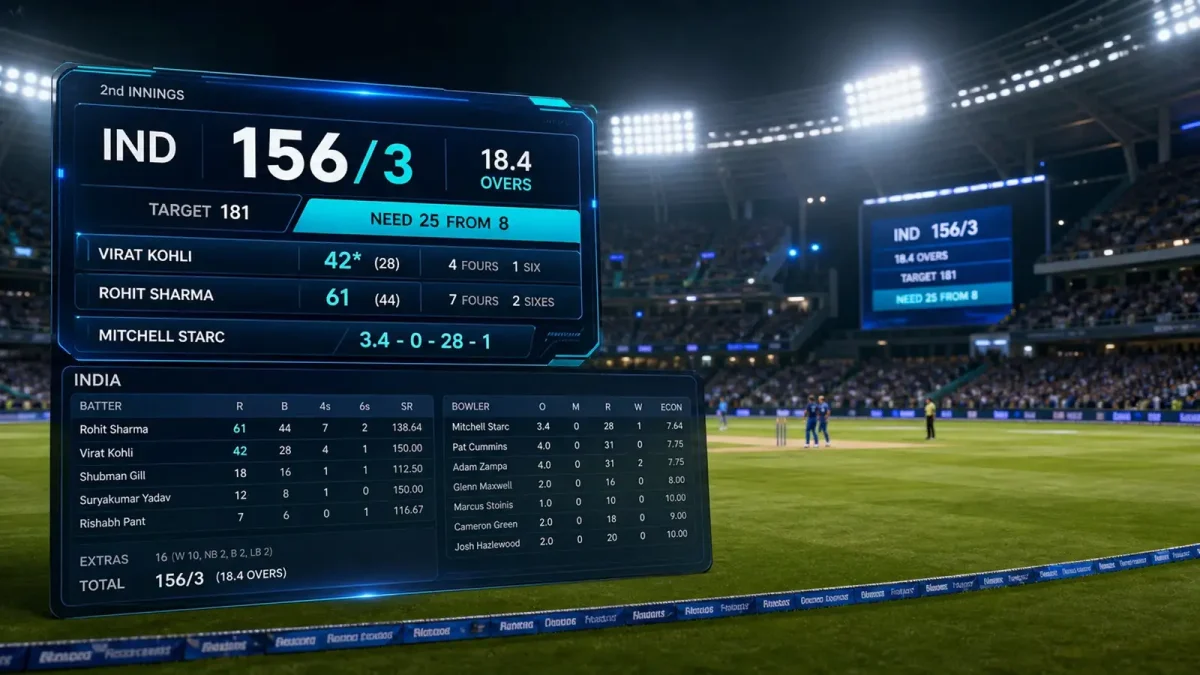

A cricket scoreboard looks confusing at first because it compresses the whole match into a few numbers: runs, wickets, overs, batters, bowler, target and run rate. This beginner guide explains how to read a cricket scoreboard on TV, in Google, in an app, at a stadium and on a full scorecard.
By the end, you will know what scores like 156/3 (18.4), 4/125, 42* (28), 1/28 (3.4), RR, RRR, SR, Econ, DLS and “wickets in hand” actually mean.
Illustrative cricket scoreboard graphic created for explanation. © CricPage
In simple words: In most countries, a cricket score is written as runs/wickets (overs). For example, 156/3 (18.4) means the batting team has scored 156 runs, lost 3 wickets, and faced 18 overs plus 4 balls. In Australia, the same score may be shown as 3/156, with wickets first.
The easiest reading order is: team score first, wickets lost second, overs third, then the two current batters, current bowler and chase equation if there is a target.
Most confusion comes from four things at once: overs look like decimals but are really balls, wickets can mean wickets lost or wickets remaining depending on the phrase, live TV graphics show less detail than a full scorecard, and different broadcasters style the same information differently.
The good news is that the underlying scoring system does not change. Whether you are watching an ICC broadcast, IPL coverage, a domestic stream, a Google score box or a cricket app, the same scorecard logic sits underneath the graphic.
Every cricket score starts with three numbers. Runs is the team total. Wickets is how many batters are out. Overs is how much of the innings has been bowled, written as overs plus balls.
One over normally contains six legal balls. Wides and no-balls add runs, but they do not count as one of the six legal balls, so the bowler must bowl another delivery.
Worked example: a score of 156/3 (18.4) in a T20 match means 156 runs, 3 wickets down, 18 overs and 4 legal balls bowled. Since a T20 innings has 20 overs, that leaves 1 over and 2 balls, or 8 legal balls.
Context decides whether the score is good. 156/3 after 18.4 overs while chasing 181 is a tense chase; 156/3 in the first innings may be a platform for a finish; 156/9 means the innings is almost over.
How to read a cricket TV scoreboard graphic
Use this visual section as a quick practice board. Start with the big team score, then move left to right through overs, target, required runs, batters and bowler figures. That reading order works on most TV broadcasts, score apps and stadium screens.
Simplified cricket scoreboard example for learning purposes. Real broadcast graphics differ by broadcaster, but the reading order is usually team, score, overs, batters, bowler, target and chase equation.
How to read a full cricket scorecard
After the live scorebug, the full scorecard tells the story behind the numbers: who made the runs, how each batter got out, which bowlers took wickets, and how extras or partnerships changed the innings.
| Batter | R | B | 4s | 6s | SR |
|---|---|---|---|---|---|
| Rohit Sharma c Smith b Starc | 61 | 44 | 7 | 2 | 138.63 |
| Virat Kohli not out | 42 | 28 | 4 | 1 | 150.00 |
| Extras | 9 | wides, no-balls, byes, leg byes | |||
| Bowler | O | M | R | W | Econ |
|---|---|---|---|---|---|
| Mitchell Starc | 3.4 | 0 | 28 | 1 | 7.63 |
| Adam Zampa | 4 | 0 | 31 | 2 | 7.75 |
| Team total | 156/3 in 18.4 overs | ||||
Simplified cricket scorecard example for learning purposes. The batting card explains who scored the runs and how each wicket fell; the bowling card explains who conceded the runs, who took wickets and how expensive each bowler was.
How an on-field scoreboard is operated
At the ground, the official score is still built ball by ball. Umpire signals, scorer entries, broadcast graphics and stadium boards all flow from the same scoring events, which is why learning the scorecard language helps everywhere.
Illustrative on-field scoreboard example for learning purposes. At grounds, scorers update the official score from umpire signals; stadium boards may show fewer details than TV, but the same scorecard data sits behind both.
The single most common mix-up is the word wickets. In the score 156/7, seven wickets have fallen and only three remain. But if a commentator says a team has 7 wickets in hand, that means only three wickets have fallen.
Another common mistake is reading 18.4 overs as a decimal. It is not 18.4 out of 20. It is 18 overs and 4 balls, because an over has six legal balls.
Dismissal shorthand is another beginner hurdle. On a scorecard, c Smith b Starc means caught by Smith, bowled by Starc. lbw b Zampa means out leg before wicket off Zampa. run out means the fielding side broke the wicket before the batter made their ground.
Once these basics click, read the scoreboard in layers: first the match situation, then the batters and bowler, then the deeper scorecard details. That habit keeps the article useful for complete beginners and for fans who already understand the score but want to read the match more intelligently.
This is one of the most-searched cricket scoreboard questions because it changes meaning with phrasing. 156/7 means seven wickets lost. Won by 7 wickets means the chasing team still had seven wickets left. 7 wickets in hand also means seven wickets remaining.
So read the phrase around the number: score line equals wickets lost; result margin or commentary phrase often means wickets remaining.
None of these numbers require calculation on your part because broadcasts and apps compute them live. The key is knowing what each number represents. For the formal scoring framework behind overs, runs and scorers, see the MCC Laws of Cricket.
When rain interrupts a limited-overs match, a chasing target may be recalculated. DLS adjusts the target using overs and wickets because a team with 10 wickets left and 10 overs left has more resources than a team with 4 wickets left and 10 overs left.
If a broadcast shows a DLS par score, it is telling you the score the chasing team needs to be level at that exact moment. If the team is above par when rain ends the match, it is usually ahead.
A TV scoreboard graphic usually shows the match essentials in one bar: team score, wickets, overs, batters, bowler figures, target and required runs. Official tournament broadcasts, league broadcasts and score apps may style the bar differently, but the information is the same.
A full scorecard goes deeper than a TV graphic. It shows the entire batting card, bowling analysis, fall of wickets, extras, partnerships and dismissals. Use the TV graphic for live context; use the full scorecard to understand how the innings was built.
Search-result score boxes are built for quick checks. They usually show only the score, overs, innings status and result. If you want strike rate, economy rate, fall of wickets or dismissal details, open the full scorecard.
The underlying scoring format is the same globally, but presentation can differ. Most countries show runs/wickets, such as 156/3. Australian coverage often shows wickets/runs, such as 3/156. Both mean the same thing: 156 runs, 3 wickets lost.
Broadcasters also choose different colours, abbreviations and layouts. Credit the broadcast design, but do not relearn the scoring system each time: read the team total, wickets, overs, batters, bowler and chase requirement in that order.
A cricket scoreboard shows three core numbers — runs scored, wickets lost, and overs bowled — usually written as Runs/Wickets (Overs), for example 156/3 (18.4). Broadcast and app scoreboards add extra detail on top of this, like current batters, the bowler’s figures, and the run rate.
Start with the main line: runs, wickets, and overs. From there, a batter’s figures are shown as runs (balls faced), for example 42 (28), and a bowler’s figures are shown as wickets/runs (overs), for example 1/28 (3.4). Everything else on a scoreboard builds on these two formats.
A cricket score is written as Runs/Wickets (Overs) — for example, 156/3 (18.4) means 156 runs, 3 wickets lost, and 18 overs and 4 balls bowled. Some broadcasters reverse the order to Wickets-Runs, so always check which number moves fastest to confirm which is which; runs almost always climb faster than wickets.
It depends on the phrasing. “156/7” means 7 wickets have fallen. “7 wickets in hand” means the opposite — only 3 are down. “Won by 7 wickets” describes a winning margin in a chase, meaning the team still had 7 wickets left when they reached the target.
A full post-match scorecard breaks the innings down into a batting table (runs, balls faced, fours, sixes, strike rate, and how each batter was dismissed) and a bowling table (overs, maidens, runs conceded, and wickets for each bowler), plus a breakdown of extras and the fall of wickets.
AB Ankit is Editor-in-chief of CricPage.
Fixtures, series and local match times.
Team and player rankings hub.
Leg Before Wicket rules, DRS and scorecard shorthand.