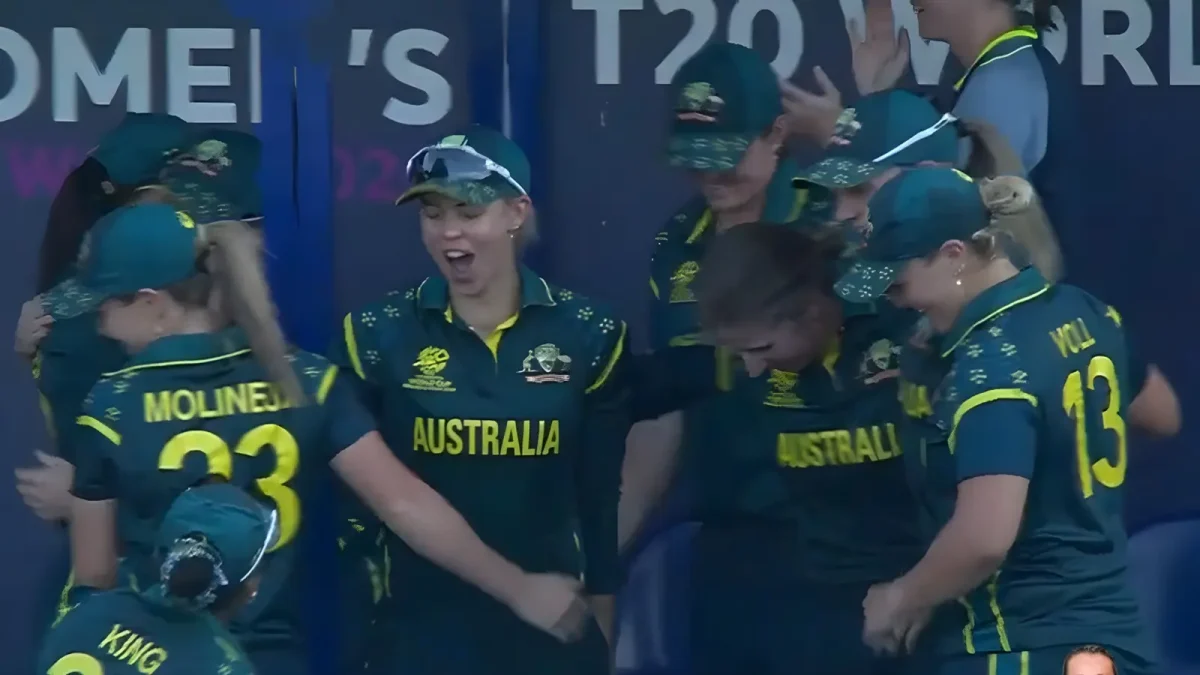

Australia’s latest Women’s T20 World Cup victory was not just another trophy lift. It was a reminder that the strongest dynasty in women’s cricket can change captains, refresh roles, bring younger players through and still own the biggest nights. At Lord’s on July 5, 2026, Australia beat England by seven wickets, chased 151 in 17.1 overs, and turned a sold-out final into their seventh Women’s T20 World Cup crown.
Australia celebrate their ICC Women’s T20 World Cup 2026 triumph at Lord’s after beating England by 7 wickets in the final. © ICC
The beauty of this win was its balance. Beth Mooney controlled the chase, Phoebe Litchfield broke the pressure with fearless stroke-play, Sophie Molineux led an unbeaten campaign in her first global tournament as captain, and the bowling unit squeezed England before the chase even began. Australia did not win because of one superstar. They won because their system keeps producing match-winners.
Australia are the 2026 ICC Women’s T20 World Cup champions after defeating England by seven wickets at Lord’s. Beth Mooney made 64 off 49 balls, Phoebe Litchfield added 48 off 35, England finished on 150/4, and Australia reached 153/3 in 17.1 overs. It was Australia’s seventh Women’s T20 World Cup title and their 14th women’s World Cup overall.
This title matters because it came after questions that most teams would find destabilising. Australia had moved into a new leadership cycle, had younger players taking important roles, and had recently experienced rare exits in global tournaments. For almost any other team, that would feel like a rebuild. For Australia, it became a reset.
The final showed why their dominance is deeper than a single era. Georgia Voll gave the chase early intent, Litchfield supplied left-handed power, Mooney gave it control, and Ellyse Perry and Ashleigh Gardner calmly finished the job. Around them, Lucy Hamilton, Kim Garth, Annabel Sutherland and Molineux kept England from getting away. That is the signature of a champion side: when one plan bends, another one appears.
England had enough experience to trouble Australia, but the final moved Australia’s way early. Amy Jones and Danni Wyatt-Hodge were gone before England could build a powerplay platform. Nat Sciver-Brunt, carrying England again after returning from a calf injury, made an unbeaten 58 from 53 balls. Freya Kemp’s 44 not out from 28 balls gave England late speed and helped lift the hosts to 150/4.
Australia answered with the clarity of a side that knew exactly how it wanted to chase. Voll struck the first ball for four, Mooney and Litchfield turned the powerplay into 62/1, and their 100-run stand in 67 balls broke the contest. When Mooney fell for 64 and Litchfield for 48, Australia were already close enough for Perry and Gardner to close the final with 17 balls remaining.
| Snapshot | Detail | Why it mattered |
|---|---|---|
| Final result | Australia beat England by seven wickets | Australia ended England’s perfect home World Cup run and lifted a record-extending seventh title. |
| England score | 150/4 in 20 overs | Nat Sciver-Brunt’s 58* and Freya Kemp’s 44* repaired the innings after early wickets. |
| Australia score | 153/3 in 17.1 overs | The chase became the highest successful run chase in a Women’s T20 World Cup final. |
| Match-winner | Beth Mooney 64 off 49 balls | Mooney added another final-defining innings and was named Player of the Match and Player of the Tournament. |
| Breakthrough knock | Phoebe Litchfield 48 off 35 balls | Her power took pressure off Mooney and changed the chase before England could settle. |
| Category | Top names | Snapshot |
|---|---|---|
| Leading run-makers | Danni Wyatt-Hodge, Beth Mooney, Nat Sciver-Brunt | Wyatt-Hodge finished with 302 runs, Mooney with 238, and Sciver-Brunt with 227. |
| Leading wicket-takers | Sree Charani, Sophie Molineux, Fatima Sana | Charani topped the wicket list with 14 wickets, while Molineux and Fatima Sana were also among the standout bowlers. |
| Best all-round impact | Ashleigh Gardner, Sophie Molineux, Marizanne Kapp | These players changed games with balance, match-ups and phase control, not just one headline statistic. |
| Semifinalists | Australia, England, West Indies, South Africa | The knockout group showed Australia’s depth, England’s revival, West Indies’ power and South Africa’s experience. |
This snapshot is built for quick scanning: final result, title count, top performers, farewell threads and live ranking context are separated so readers can understand the full story without digging through a scorecard.
| # | Player | Country | Rating | Chg |
|---|---|---|---|---|
| 1 | Australia Women | Australia | 290 | - |
| 2 | England Women | England | 277 | - |
| 3 | India Women | India | 262 | - |
| 4 | New Zealand Women | New Zealand | 249 | - |
| 5 | South Africa Women | South Africa | 245 | - |
| 6 | Sri Lanka Women | Sri Lanka | 238 | - |
| 7 | West Indies Women | West Indies | 237 | - |
| 8 | Pakistan Women | Pakistan | 210 | - |
| 9 | Ireland Women | Ireland | 203 | - |
| 10 | Bangladesh Women | Bangladesh | 196 | - |
Mooney’s innings was the perfect final knock because it never looked hurried. She scored at pace without giving England a cheap opening and produced her third half-century in a Women’s T20 World Cup final, after earlier final fifties in 2020 and 2023. That gives her a special place in the tournament’s knockout history: she is not only consistent; she is repeatable under the heaviest pressure.
Litchfield’s 48 was almost as important. The scorecard says she missed a fifty, but the match situation says she removed England’s belief. Her six fours and two sixes forced the field back, changed the pace of the chase and allowed Mooney to keep steering. It was also a statement for Australia’s next cycle: the younger group is not waiting for permission to take over big games.
The best all-round impact belonged to the players who changed two phases of the game, not only one scorecard column. Gardner remained Australia’s most flexible match-up player, Sutherland gave balance with seam and late-order hitting, and Molineux added captaincy value to her left-arm spin. Across the tournament, Charani’s wickets, Mooney’s runs and Wyatt-Hodge’s volume stood out, but Australia’s edge was that their all-rounders made the XI longer than everyone else’s.
The live rankings block below uses the CricPage Rankings plugin. It should automatically reflect the latest imported women’s T20I team ranking data from your plugin CSV or root upload workflow, keeping the article useful after the World Cup buzz settles.
These numbers make the win easy to scan, but the bigger story sits underneath them: Australia combined power, experience, phase control and calm finishing better than every other side in the tournament.
The winners list explains why Australia’s 2026 success feels bigger than one final. Since the tournament began in 2009, Australia have won seven of the ten editions, while England, West Indies and New Zealand have one title each. For tournament details and future updates, visit the official ICC Women’s T20 World Cup hub.
| Edition | Host | Winner | Runner-up | Final result | Why it matters |
|---|---|---|---|---|---|
| 2009 | England | England | New Zealand | England won by 6 wickets | First Women’s T20 World Cup title. |
| 2010 | West Indies | Australia | New Zealand | Australia won by 3 runs | Australia’s first title and the start of their T20 dynasty. |
| 2012 | Sri Lanka | Australia | England | Australia won by 4 runs | Back-to-back title under pressure. |
| 2014 | Bangladesh | Australia | England | Australia won by 6 wickets | Three consecutive trophies confirmed a dominant era. |
| 2016 | India | West Indies | Australia | West Indies won by 8 wickets | West Indies broke Australia’s run with a famous chase. |
| 2018 | West Indies | Australia | England | Australia won by 8 wickets | Australia returned to the top with a complete knockout campaign. |
| 2020 | Australia | Australia | India | Australia won by 85 runs | Home triumph at the MCG became a landmark women’s cricket moment. |
| 2023 | South Africa | Australia | South Africa | Australia won by 19 runs | Australia held off a rising home side in Cape Town. |
| 2024 | United Arab Emirates | New Zealand | South Africa | New Zealand won by 32 runs | New Zealand claimed their first Women’s T20 World Cup crown. |
| 2026 | England | Australia | England | Australia won by 7 wickets | Australia lifted a record-extending seventh title at Lord’s. |
Australia’s Women’s T20 World Cup record is now extraordinary: seven titles in ten editions. The 2026 crown joined wins in 2010, 2012, 2014, 2018, 2020 and 2023, making them the clear standard in the format. What separates them is not just talent, but role clarity. Openers attack, middle-order players adapt, all-rounders give balance, and bowlers are trusted to win match-ups rather than simply defend totals.
There was no need to invent a dramatic retirement scene in the final. The confirmed farewell thread around the tournament was broader. Megan Schutt had already indicated this would be her final major ICC campaign, even though she had not fixed an exact international retirement date. For Australia, lifting another trophy in that window still gave a veteran of the dynasty a fitting global sign-off.
The most emotional international farewells came from New Zealand’s greats. Suzie Bates, Sophie Devine and Lea Tahuhu ended their international careers after New Zealand were eliminated by England. Their exit showed the other side of World Cups: one team celebrates a dynasty, while another generation walks away without the finish it wanted.
Nat Sciver-Brunt, by contrast, said after England’s final defeat that she did not want this to be her last World Cup. That keeps England’s leadership story open, especially because her semifinal and final runs showed how much value she still brings when the pressure is highest.
England were the strongest challenger and reached the final unbeaten, but Australia exposed the gap between a very good team and a tournament machine. England had Wyatt-Hodge’s record run tally, Sciver-Brunt’s class, Sophie Ecclestone’s control and home support, yet the final showed they still need sharper starts with the bat and more wicket-taking pressure in the middle overs.
West Indies earned a semifinal place and showed the value of power and personality, led by the kind of all-round threat Hayley Matthews brings. South Africa remained dangerous enough to reach the knockouts, with Marizanne Kapp again showing why experience and skill travel well. India missed the final stages but still produced the tournament’s leading wicket-taker in Sree Charani, a major positive for their next T20 cycle.
Australia won the ICC Women’s T20 World Cup 2026 by defeating England by seven wickets in the final at Lord’s.
Australia have now won seven Women’s T20 World Cup titles: 2010, 2012, 2014, 2018, 2020, 2023 and 2026.
Beth Mooney was the final’s standout batter with 64 off 49 balls and was named Player of the Match.
Danni Wyatt-Hodge led the tournament with 302 runs. Beth Mooney and Nat Sciver-Brunt were also among the leading scorers.
Megan Schutt treated the tournament as her final major ICC campaign, while New Zealand greats Suzie Bates, Sophie Devine and Lea Tahuhu ended their international careers after New Zealand’s exit.
AB Ankit is Editor-in-chief of CricPage.
Result, score, chase and title count
Mooney, Litchfield, bowlers and all-rounders
Live ICC women’s T20I team rankings.
Upcoming fixtures, series and local match times.