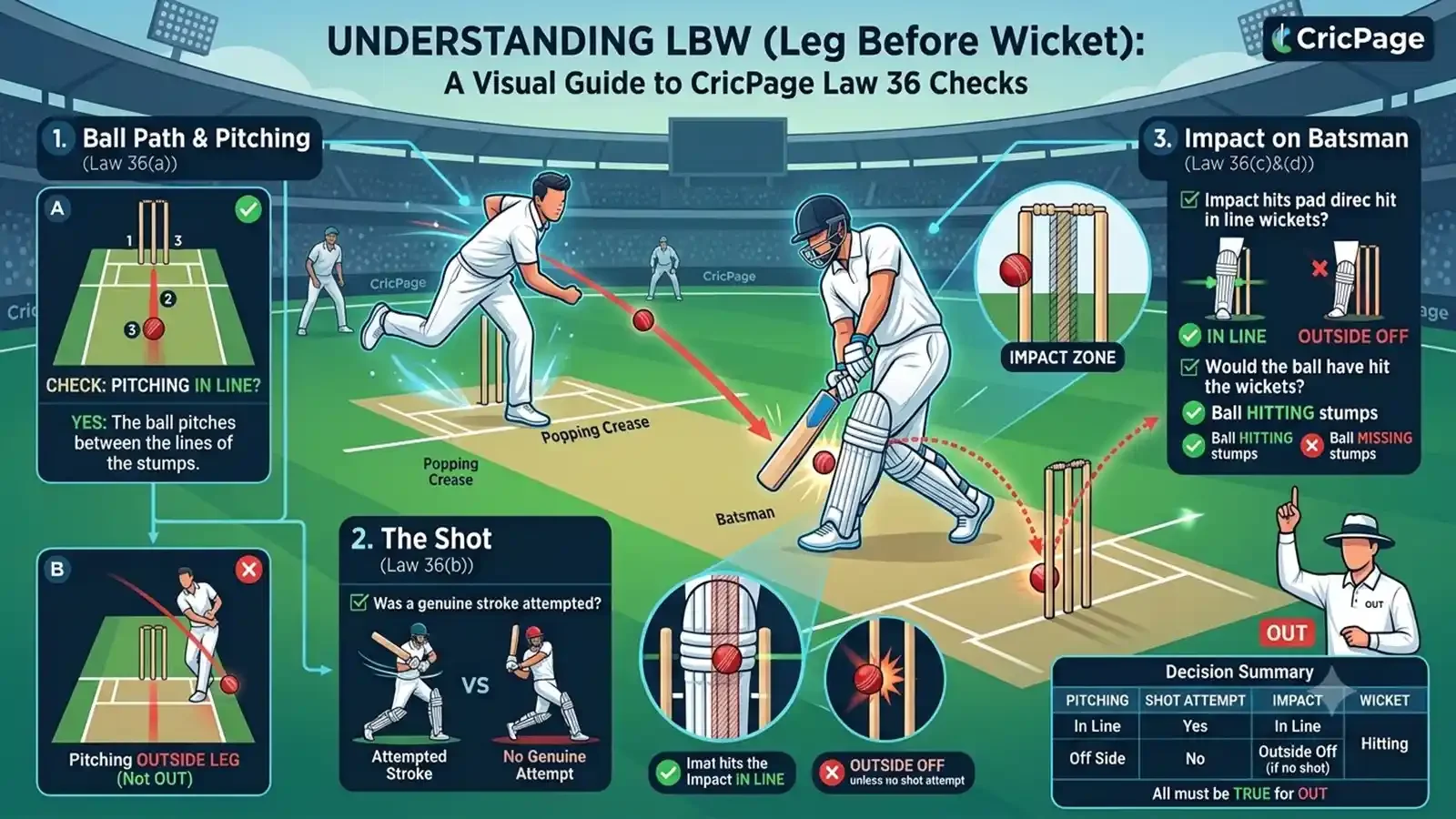

LBW in cricket means Leg Before Wicket. It is the dismissal where a legal ball hits the batter’s body before the bat, and the umpire judges that the ball would have hit the stumps if the body had not blocked it.
The rule sounds simple until a real appeal happens. Pitching line, impact line, bat-before-pad, no-ball checks, DRS and Umpire’s Call can all change the answer. This guide explains the LBW rules in match language, then shows how lbw b bowler appears on a scorecard.
The simple meaning of LBW is this: the batter’s body has blocked a ball that was likely to hit the wicket. The word leg is historical because most LBW decisions involve the pad, but the law is not limited to legs. If the ball first hits the arm, shoulder or another part of the body, LBW can still be possible if the other conditions are satisfied.
The key phrase is before wicket. The body is in front of the wicket and stops the ball from reaching the stumps. The umpire is not only judging where the ball hit; they are judging the whole path: where it pitched, where it struck the batter and whether it would have hit the stumps.
The first LBW explanation most fans hear is simple: the ball hits the pad and would have hit the stumps. That is useful, but real appeals turn on smaller details: whether the ball was legal, whether it touched the bat first, where it pitched, where it hit the batter, whether a genuine shot was offered, and what the ball was likely to do next.
Once those details are clear, LBW in cricket becomes much easier to follow. The same delivery can look out to one viewer and not out to another because one small detail — especially impact outside off or pitching outside leg — changes the whole decision.
| Beginner question | Simple answer |
|---|---|
| What is LBW in cricket? | LBW means Leg Before Wicket: the batter can be out if the ball hits the body before the bat and would have hit the stumps. |
| Can LBW happen outside off stump? | Yes. The answer depends on where impact happened and whether the batter made a genuine attempt to play the ball. |
| Can LBW happen outside leg stump? | If the ball pitches outside leg stump, LBW is not out, even if the projected path later hits the stumps. |
| How long do players get for DRS? | A Player Review must be requested within 15 seconds after the ball becomes dead. |
| How does a scorecard show LBW? | The dismissal is written as lbw b bowler. The bowler gets the wicket; no fielder is credited. |
Last updated: July 8, 2026
A useful way to read any LBW appeal is to go step by step: legal ball, no bat first, valid pitching line, valid impact line, and a projected path that hits the stumps.
The official LBW rule is MCC Law 36: Leg before wicket. MCC lists five circumstances that must all apply: the delivery is not a no-ball, the ball pitches in a valid area, the ball hits the striker’s person before the bat, the impact is in a valid area, and the ball would have hit the wicket. You can read the official law here: MCC Law 36: Leg before wicket.
For beginners, the important point is that LBW is a chain. It is not one decision. Umpires move through the chain quickly, but every link must survive.
These five checks explain most LBW decisions you will see on TV, in a scorecard or in a match report. The order matters. A no-ball ends the question before line or height is discussed. A clear inside edge also ends it because LBW only applies when the body is struck before the bat.
The common mistake is to watch only the final stumps graphic. That is just the last check. A ball can be shown hitting the stumps and still be not out if it pitched outside leg, hit the bat first or struck the batter outside off while a genuine shot was being played.
The shot/no-shot question is the part of Leg Before Wicket that creates the most arguments. When a batter plays a genuine shot and the ball hits outside the line of off stump, the batter is normally protected from LBW. But when the batter shoulders arms, leaves the ball, hides the bat or makes no genuine attempt to play, that outside-off protection can disappear.
Example: a right-arm seamer brings the ball back from outside off. If the batter steps forward and tries to drive, impact just outside off can be not out. If the batter shoulders arms to the same ball and it hits the pad outside off before crashing into the stumps, the batter can be out because no genuine shot was offered.
These are the LBW examples that cause the most confusion in live cricket: pitching outside leg, impact outside off, no shot offered, full tosses, bat first, no-balls and unusual body contact.
| LBW situation | What the umpire checks | Likely decision |
|---|---|---|
| Ball pitches outside leg stump | The pitching check fails even if the ball would have hit the stumps. | Not out. |
| Full toss hits pad in line | No pitching check is needed because the ball did not bounce; impact and wickets still matter. | Out if impact and wicket path are both valid. |
| Shot played, impact outside off | A genuine shot protects the batter when impact is outside the off-stump line. | Not out. |
| No shot, impact outside off | The outside-off protection can disappear when the batter offers no genuine shot. | Can be out if the other checks pass. |
| Bat touches first, then pad | LBW requires body contact before bat contact. | Not out. |
| No-ball | The legal-delivery check fails immediately. | Not out. |
| Ball hits arm, shoulder or body | Law 36 covers any part of the striker's person, not only the leg pad. | Can be out, but it is rare. |
| Reverse sweep or switch-hit | Off side is judged from the striker's position when the ball comes into play for that delivery. | Judged against the original stance. |
Last updated: July 8, 2026
DRS does not create a separate LBW law. It helps the third umpire check the same cricket questions: where the ball pitched, where it hit the batter, whether the bat was involved first and whether the projected path was hitting the wickets. The TV graphic usually labels the three ball-tracking checks as Pitching, Impact and Wickets.
Umpire’s Call appears when impact or wickets are too close to overturn the on-field call. That is why a review can show the ball clipping the stumps but the batter still survives if the original decision was not out. The reverse can also happen: a clipping result can stay out if the umpire originally raised the finger.
| DRS zone | What it means in LBW | Beginner reading |
|---|---|---|
| Pitching | Where the ball landed on the pitch before hitting the batter. | Outside leg means not out; in line or outside off can continue. |
| Impact | Where the ball first struck the batter's body. | In line is strongest; outside off depends on whether a shot was offered. |
| Wickets | The predicted path after impact and whether it would hit the stumps or bails. | Missing is not out; hitting is out if the other checks pass; marginal results may stay with the on-field umpire. |
Last updated: July 8, 2026
LBW and DRS still divide cricket because a close review is not always a simple yes-or-no moment. The law is checked first, then ball-tracking estimates the path after impact. On top of that, Umpire’s Call can keep the original decision when the projection is marginal.
That mix is why two similar deliveries can feel different to fans. One may be overturned because most of the ball is hitting the stumps; another may stay with the umpire because only a small part of the ball is clipping the required zone.
| Cricket voice | Short quoted view | Why the view matters |
|---|---|---|
| Sachin Tendulkar | "let the technology take over" | This is the argument for removing the grey area once an LBW decision has gone upstairs. |
| Nasser Hussain | "margin for error in technology" | This explains why some experts still support a buffer on very tight ball-tracking projections. |
| Michael Atherton | "I believe umpire's call is necessary." | This reflects the view that DRS should correct clear mistakes rather than replace every close umpiring judgment. |
| Kumar Sangakkara | "The result of a review should not be ambiguous." | This is the clarity argument many fans understand: once the replay is shown, they want a clean answer. |
| Sunil Gavaskar | "I am questioning the technology" | This shows why some LBW reviews remain heated when the graphic does not match what viewers expected live. |
| Ricky Ponting | "They can't trust it." | This captures the trust issue that still follows review technology when players or fans doubt what they are seeing. |
Before DRS, most LBW appeals ended with the umpire’s live decision. If an inside edge was missed, the pitching line was misread, or the ball looked straight but was actually going over the stumps, the batting or fielding side had little chance to correct it.
DRS changed that balance. It gives teams a way to challenge clear mistakes and lets the third umpire review bat contact, pitching, impact, height and the projected path. For LBW, that matters because the decision is not based only on what happened; it also asks what would have happened if the batter’s body had not blocked the ball.
| LBW howler DRS can fix | What the review checks | Why it matters |
|---|---|---|
| Inside edge missed live | UltraEdge/Snicko and replay can show bat before pad. | If bat came first, LBW should not stand. |
| Ball pitched outside leg | Ball-tracking checks the pitching point. | Outside leg pitching is a simple not-out for LBW. |
| Impact outside off with a shot | The third umpire checks the impact point and whether a genuine shot was offered. | A batter playing a shot gets protection when impact is outside off. |
| Ball missing or going over | Ball-tracking projects whether the ball would hit the stumps. | Replays can overturn an out decision if the ball was missing. |
| No-ball or illegal delivery | The third umpire can check whether the delivery itself was legal. | A no-ball cannot produce an LBW dismissal. |
Last updated: July 8, 2026
That is why DRS has been valuable without making LBW completely argument-free. It can overturn obvious howlers, but very tight calls still leave room for debate because ball-tracking has margins and the original on-field decision still matters under Umpire’s Call.
An LBW dismissal is written in a scorecard as lbw b [Bowler]. For example, lbw b Starc 42 means the batter scored 42 runs and was out leg before wicket to a ball bowled by Starc. There is no fielder in the dismissal because no catch, stumping or run-out was involved.
Compare that with c Root b Anderson, where the fielder Root took the catch and Anderson bowled the ball. In LBW, the bowler alone receives the wicket credit. This is why the scorecard uses the short form lbw b instead of listing a catcher or wicketkeeper.
Myth 1: It must hit the leg. No. LBW can involve any part of the person, although the pad is the usual contact point.
Myth 2: Hitting the pad in front is always out. No. Pitching, bat contact, impact and projected path all matter.
Myth 3: Outside off is always not out. Not always. If no genuine shot is offered, impact outside off can still lead to LBW.
Myth 4: DRS decides everything from scratch. No. DRS checks whether the on-field decision should be overturned. Umpire’s Call exists for close impact and wicket zones.
Myth 5: Height does not matter. It does. If the ball is predicted to pass over the bails, the batter is not out LBW even if the line looked straight.
LBW exists because cricket needed a way to stop batters from using their pads as a second bat. Early cricket laws did not have the modern LBW rule. As bats became straighter and defensive pad play became more practical, lawmakers tightened the dismissal so that a batter could not simply stand in front of the wicket and block the ball with the body.
The modern rule has been adjusted across cricket history, but the principle is still the same: the batter should not gain unfair protection by letting the body stop a ball that would otherwise hit the wicket.
LBW has changed because batting changed. The law began as a way to stop deliberate pad-blocking and slowly became more precise about pitching, impact, the batter’s shot and the predicted path to the stumps.
The timeline below keeps the history short, but it also shows why modern LBW decisions still revolve around the same questions: where did it pitch, where did it hit, was there bat first, was a real shot played, and would the ball have hit the wicket?
| Period | LBW law change | Why it matters for beginners |
|---|---|---|
| 1744 | The earliest known written Laws of Cricket did not yet contain the modern LBW dismissal. | Early cricket did not need the same leg-before-wicket protection because batting style and bat shape were different. |
| 1774 | Leg before wicket was introduced to stop batters from deliberately using the leg to block a ball that would hit the wicket. | This is the reason LBW exists: the body should not become a second bat in front of the stumps. |
| 1839 | The wording around the ball pitching in line became central to how LBW was judged. | This is the origin of the pitching-line question fans still ask today. |
| 1935–1937 | The law was expanded after experiments so a batter could be LBW even when the ball pitched outside off stump. | This made pad-play riskier and brought more attacking bowling back into the contest. |
| 1972–1980 | The no-genuine-shot idea became part of the modern LBW shape: impact outside off can still be out if the batter does not genuinely try to play the ball. | This is why “shot offered or no shot?” matters so much in LBW appeals. |
| DRS era | Replays, edge detection and ball-tracking changed LBW decision-making without changing the core MCC Law 36 checks. | DRS helps correct clear howlers, but Umpire’s Call still protects marginal live decisions. |
| Updated 2026 | As of July 2026, the current MCC Law 36 still asks the same essentials: legal delivery, no bat first, valid pitching, valid impact and a ball that would hit the wicket. | The law has history, but the practical beginner checklist remains stable. |
Timeline checked against MCC Law 36 and widely cited historical summaries of the LBW law. Last updated: July 8, 2026
Cricket is usually explained through 10 dismissal types. Most are simple to spot on a replay: bowled, caught, run out or stumped. LBW is the one that needs the most explanation because it asks the umpire to judge line, bat contact and the likely path of the ball.
The table below keeps the full dismissal list short, but the highlighted row shows why LBW / Leg Before Wicket remains one of cricket’s most important and most discussed laws.
| # | Dismissal type | MCC law | Simple meaning |
|---|---|---|---|
| 1 | Bowled | Law 32 | The ball puts down the wicket after being delivered. |
| 2 | Caught | Law 33 | A legal catch is completed after the batter hits the ball. |
| 3 | Hit the ball twice | Law 34 | The striker illegally strikes the ball a second time. |
| 4 | Hit wicket | Law 35 | The striker breaks their own wicket while playing the ball or setting off for a run. |
| 5 | LBW / Leg Before Wicket | Law 36 | The ball hits the batter before the bat and would have hit the wicket, provided the line rules are satisfied. |
| 6 | Obstructing the field | Law 37 | The batting side wilfully obstructs or distracts the fielding side. |
| 7 | Run out | Law 38 | A wicket is fairly broken while a batter is out of their ground. |
| 8 | Stumped | Law 39 | The wicket-keeper breaks the wicket while the striker is out of ground and not attempting a run. |
| 9 | Timed out | Law 40 | The incoming batter is not ready in time after a wicket or retirement. |
| 10 | Retired out | Law 25.4.3 | A batter retires for a reason other than illness, injury or unavoidable cause and does not resume. |
MCC lists the main dismissal laws from Law 32 to Law 40, while retired out is recorded under Law 25.4.3. Last updated: July 8, 2026.
LBW stands for Leg Before Wicket. It is a dismissal where the ball hits the batter’s body before the bat and, in the umpire’s opinion, would have gone on to hit the wickets.
No. A no-ball cannot produce an LBW dismissal, even if the ball pitches in line, hits the pad in line and is going on to hit the stumps.
Yes. If the ball pitches outside the line of leg stump, the LBW appeal fails. This is one of the simplest LBW rules for beginners to remember.
Yes, but mainly when the batter has made no genuine attempt to play the ball. If the batter plays a genuine shot and impact is outside off, it is normally not out.
Umpire’s Call means the ball-tracking result is too marginal to clearly overturn the on-field decision. The original decision stays, and in many playing conditions the reviewing team keeps the review.
It is usually written as lbw b [Bowler]. For example, lbw b Bumrah means the batter was out leg before wicket and Bumrah was credited with the wicket.
AB Ankit is Editor-in-chief of CricPage.