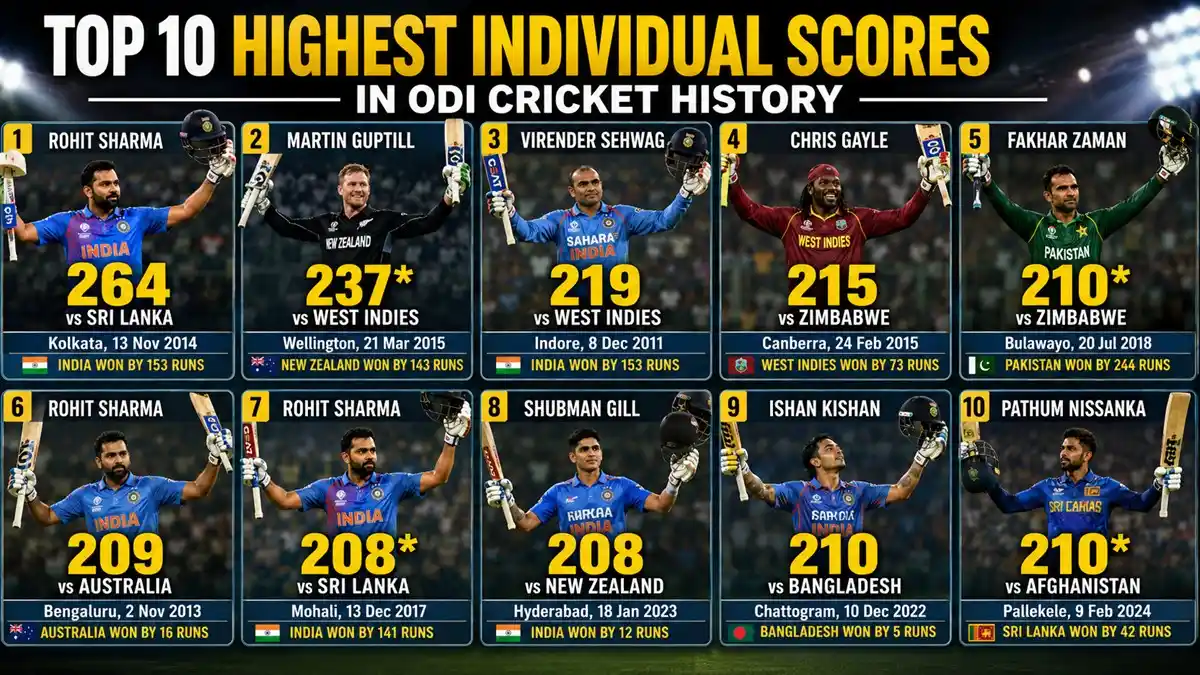

Nothing satisfies a batter more than dominating 50 overs. This rebuilt article retains the complete ten-innings list, every venue, date, result and context note, the additional 200-plus score section, batting-evolution analysis and final assessment.
The highest individual scores in ODI cricket history showcase the ultimate dominance of a batter in a 50-over match. These innings are not only about runs—they represent endurance, skill and mental strength under pressure.
From double centuries to record-breaking knocks, players such as Rohit Sharma and Martin Guptill redefined what is possible in ODI cricket. The complete list below preserves the original match context, results and legacy notes.
“From moments of sheer brilliance to unstoppable dominance, the highest individual scores in ODI history are not just numbers—they are acts of greatness. Batters did not simply score big; they owned the game, crushed bowling attacks and rewrote expectations.
Legends such as Rohit Sharma, Virender Sehwag and Chris Gayle did not only break records—they shattered perceived limits. Records will be broken, but the aura, fear and inspiration created by these innings will echo through cricket forever.”
The highest ODI scores show how modern cricket allows a batter to control an entire innings and dominate a complete bowling attack.
A record innings usually combines a measured start with increasingly aggressive scoring. Rohit Sharma’s 264 is presented in the source as the clearest example: a slow opening phase followed by complete domination in the later overs.
| Rank | Batter | Score | Opponent | Venue | Date | Result |
|---|---|---|---|---|---|---|
| 1 | Rohit Sharma | 264 | Sri Lanka | Kolkata | 13 November 2014 | India won by 153 runs |
| 2 | Martin Guptill | 237* | West Indies | Wellington | 21 March 2015 | New Zealand won by 143 runs |
| 3 | Virender Sehwag | 219 | West Indies | Indore | 8 December 2011 | India won by 153 runs |
| 4 | Chris Gayle | 215 | Zimbabwe | Canberra | 24 February 2015 | West Indies won by 73 runs |
| 5 | Fakhar Zaman | 210* | Zimbabwe | Bulawayo | 20 July 2018 | Pakistan won by 244 runs |
| 6 | Ishan Kishan | 210 | Bangladesh | Chattogram | 10 December 2022 | India won by 227 runs |
| 7 | Pathum Nissanka | 210* | Afghanistan | Pallekele | 9 February 2024 | Sri Lanka won by 42 runs |
| 8 | Rohit Sharma | 209 | Australia | Bengaluru | 2 November 2013 | India won by 57 runs |
| 9 | Rohit Sharma | 208* | Sri Lanka | Mohali | 13 December 2017 | India won by 141 runs |
| 10 | Shubman Gill | 208 | New Zealand | Hyderabad | 18 January 2023 | India won by 12 runs |
Venue: Kolkata
Date: 13 November 2014
Result: India won by 153 runs
Rohit Sharma holds the listed record for the highest individual score in ODI cricket. After a slow start, he exploded in the later overs, demonstrating how careful pacing can lead to a historic total.
Venue: Wellington
Date: 21 March 2015
Result: New Zealand won by 143 runs
Martin Guptill delivered a World Cup masterclass. The source identifies this as the highest individual score in World Cup history, showing dominance on the biggest stage.
Venue: Indore
Date: 8 December 2011
Result: India won by 153 runs
Virender Sehwag became only the second player to score an ODI double century. His fearless approach helped pave the way for later 200-plus scores.
Venue: Canberra
Date: 24 February 2015
Result: West Indies won by 73 runs
Chris Gayle struck a brutal double century. It was the first double century in World Cup history and became a defining example of limited-overs power-hitting.
Venue: Bulawayo
Date: 20 July 2018
Result: Pakistan won by 244 runs
Fakhar Zaman created history for Pakistan. The innings reflected Pakistan’s rise in aggressive ODI batting.
Venue: Chattogram
Date: 10 December 2022
Result: India won by 227 runs
Ishan Kishan stunned the cricket world. The source highlights the innings as the fastest ODI double century and an example of modern cricket’s attacking nature.
Venue: Pallekele
Date: 9 February 2024
Result: Sri Lanka won by 42 runs
Pathum Nissanka joined the elite double-century club. The original article describes the knock as evidence that major ODI batting records are spreading beyond the traditional leading teams.
Venue: Bengaluru
Date: 2 November 2013
Result: India won by 57 runs
Rohit Sharma appears again with another iconic innings. This was the first of his three ODI double centuries and established the repeatability of his long-innings method.
Venue: Mohali
Date: 13 December 2017
Result: India won by 141 runs
Rohit became the only player with three ODI double centuries. The source presents that consistency at the highest level as unmatched.
Venue: Hyderabad
Date: 18 January 2023
Result: India won by 12 runs
Shubman Gill announced his arrival on the biggest stage. The innings represented a new generation carrying forward India’s ODI batting dominance.
The highest individual ODI score represents peak performance—a match in which one batter controls the contest for most of 50 overs.
From Rohit Sharma’s 264 to the wider double-century club, these performances changed how teams assess possible totals and how batters pace long limited-overs innings.
The source listed Chris Gayle again as number 11, although the same 215 already appears at number four in the top ten. The duplicated note is retained here transparently rather than being discarded.
The original post included this innings as number 12 in its additional scorer section.
Venue: Gwalior
Year: 2010
Result: India won by 153 runs
The source identifies this as the first double century in ODI cricket history—an innings that changed batting expectations forever.
Rohit Sharma is listed first with 264 against Sri Lanka in Kolkata on 13 November 2014.
Martin Guptill’s unbeaten 237 against West Indies in Wellington during the 2015 World Cup is the highest World Cup score listed in the article.
The article includes three: 209 against Australia, 264 against Sri Lanka and 208 not out against Sri Lanka.
Ishan Kishan’s 210 against Bangladesh in Chattogram is identified as the fastest ODI double century.
Sachin Tendulkar’s unbeaten 200 against South Africa in Gwalior in 2010 is identified as the first ODI double century.
The article points to improved fitness, aggressive batting, better powerplay use and faster death-over scoring.
From Rohit Sharma’s historic 264 to multiple double centuries across different teams, the highest individual scores in ODI cricket define batting greatness. These innings changed how the game is played and proved that one player can dominate an entire match.
The top scores also trace ODI cricket’s evolution into a more aggressive batting format. From Sehwag’s fearless 219 to Rohit’s record 264, each performance pushed existing limits.
Records may eventually be broken, but these innings remain defining moments that will continue to inspire future generations.
AB Ankit is Editor-in-Chief of CricPage.
Opening context, headline records and the original legacy quote.
Endurance, pacing, powerplay use and late-innings acceleration.
All ten scores with opponent, venue, date and result.
Detailed context for every record performance.
The source’s Chris Gayle, Glenn Maxwell and Sachin Tendulkar notes.
Fitness, aggression, powerplays, death overs and record significance.
Six article-specific answers with FAQ schema.
The closing assessment of ODI batting greatness.
Compare all ten highest scores in one table.
Open the full match-by-match breakdown.
See the additional scorer notes retained from the source.
Quick answers about the leading ODI records.
Rohit Sharma — 264 vs Sri Lanka.
Martin Guptill — 237* vs West Indies.
Rohit Sharma — 209, 264 and 208*.
Ishan Kishan — 210 vs Bangladesh.
Sachin Tendulkar — 200* in 2010.
Pathum Nissanka — 210* in February 2024.